
Why Mobile Speed Is the New Ranking Factor
In the era of smartphones and mobile-first browsing, website speed on mobile devices has become a critical ranking factor for search engines like Google. Slow-loading mobile sites frustrate users, increase bounce rates, and can hurt your SEO rankings.
This article explores why mobile speed matters more than ever, its impact on user experience and SEO, and how JumboNIC helps businesses optimize for mobile performance.
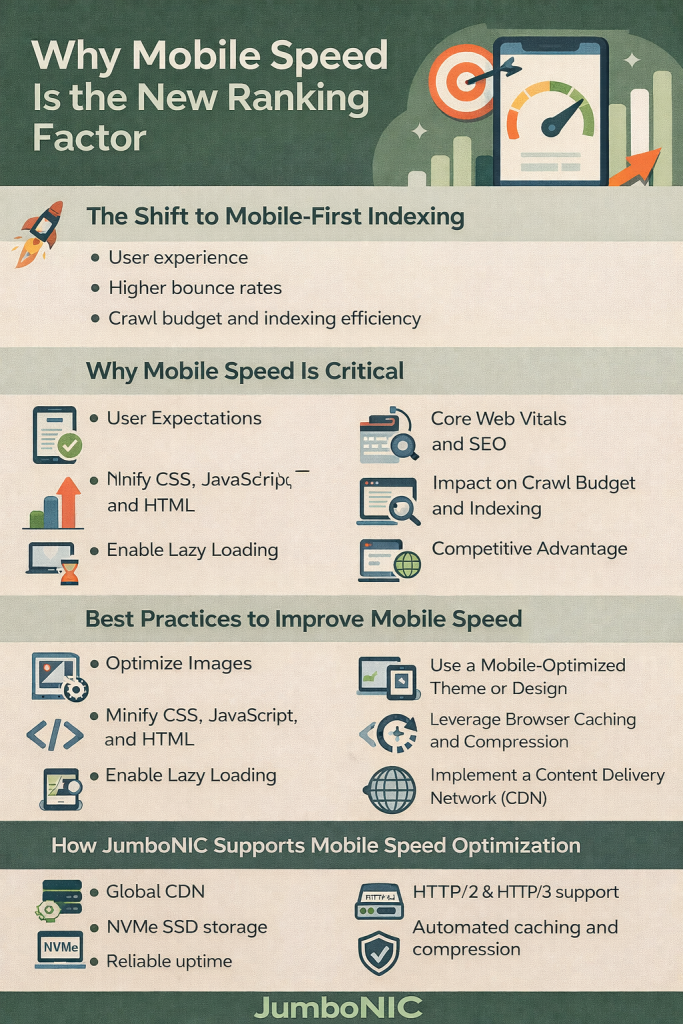
The Shift to Mobile-First Indexing
Google has moved to mobile-first indexing, which means it predominantly uses the mobile version of your website to determine search rankings. This shift makes mobile performance a major factor in SEO success.
Fast mobile websites improve user experience
Slow sites lead to higher bounce rates
Mobile speed impacts crawl budget and indexing efficiency
Why Mobile Speed Is Critical
1. User Expectations
53% of mobile users abandon sites that take more than 3 seconds to load.
Slow pages decrease engagement, reduce conversions, and negatively affect brand perception.
JumboNIC Advantage: JumboNIC’s high-performance NVMe SSDs and global CDN reduce latency and load times for mobile visitors.
2. Core Web Vitals and SEO
Google evaluates mobile performance using Core Web Vitals:
Largest Contentful Paint (LCP): Measures how quickly the main content loads
First Input Delay (FID): Measures interactivity
Cumulative Layout Shift (CLS): Measures visual stability
Mobile-friendly, fast-loading sites score higher in search rankings.
JumboNIC Advantage: JumboNIC’s hosting ensures optimized server response times and caching, improving Core Web Vitals metrics for mobile users.
3. Impact on Crawl Budget and Indexing
Mobile speed affects how efficiently Googlebot crawls your site.
Faster servers allow crawlers to index more pages in less time, improving overall search visibility.
JumboNIC Advantage: JumboNIC’s global CDN and HTTP/3 support enable fast, reliable crawling for mobile-first indexing.
4. Competitive Advantage
Mobile users are more likely to abandon competitors with slow sites.
Fast mobile performance can improve engagement, retention, and conversion rates, giving your business a competitive edge.
Best Practices to Improve Mobile Speed
Optimize Images – Use responsive images in WebP or AVIF format
Minify CSS, JavaScript, and HTML – Reduce page weight
Enable Lazy Loading – Load images and videos only when they appear in the viewport
Use a Mobile-Optimized Theme or Design – Ensure responsiveness and minimal code bloat
Leverage Browser Caching and Compression – Reduce repeated load times
Implement a Content Delivery Network (CDN) – Deliver content closer to mobile users
JumboNIC Advantage: JumboNIC includes CDN, caching, and server-side optimizations, making these performance enhancements seamless.
How JumboNIC Supports Mobile Speed Optimization
JumboNIC ensures your mobile site loads fast and efficiently:
Global CDN for near-instant content delivery
HTTP/2 & HTTP/3 support for faster connections
NVMe SSD storage for ultra-fast server response times
Automated caching and compression for minimal load times
Reliable uptime to prevent mobile user frustration
With JumboNIC, your mobile visitors enjoy smooth, fast browsing, which improves engagement and SEO rankings simultaneously.
Conclusion
Mobile speed is no longer optional—it is a critical ranking factor and a key component of user experience. Slow mobile sites frustrate users, increase bounce rates, and hurt search rankings.
By optimizing mobile performance and hosting with JumboNIC, businesses can achieve fast, secure, and reliable mobile experiences. Fast mobile websites not only satisfy users but also enhance SEO, conversions, and long-term growth.