
Why HTTPS Alone Isn’t Enough for Security: Insights from JumboNIC
In the past decade, HTTPS has become a standard for web security. You’ve probably heard that “having a padlock in the browser bar” means your site is safe. While HTTPS is a crucial foundation, it’s not a complete security solution.
At JumboNIC, we help thousands of businesses secure and optimize their digital environments — and one of the biggest misconceptions we encounter is the belief that HTTPS alone can protect a website from cyber threats.
In reality, HTTPS is just the first step in a much larger cybersecurity framework.
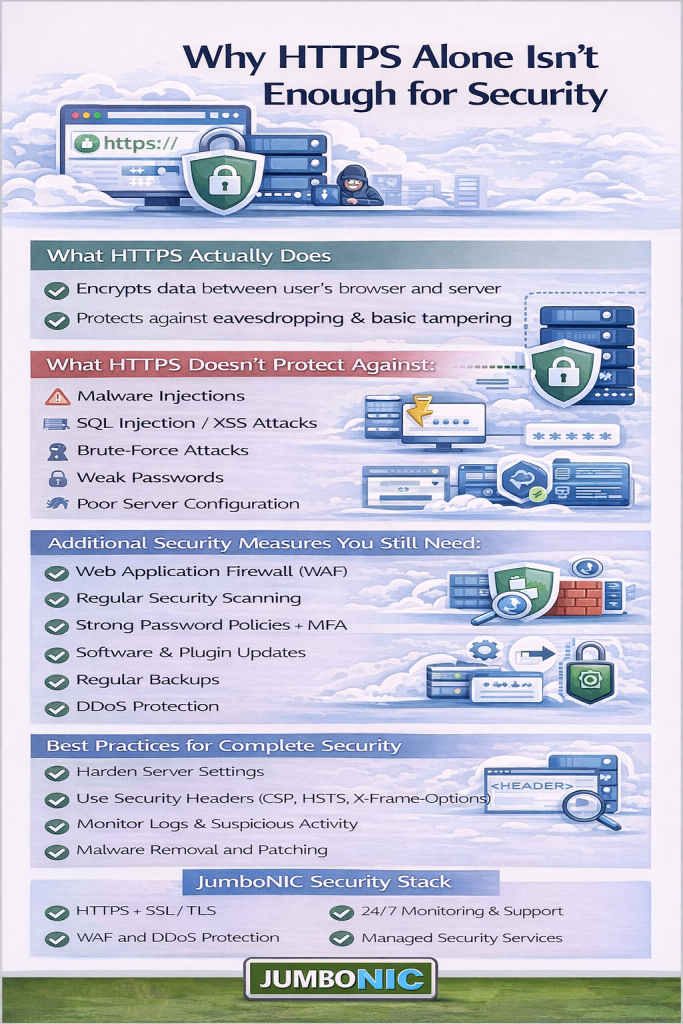
1. What HTTPS Really Does
HTTPS (Hypertext Transfer Protocol Secure) encrypts the connection between your website and its visitors. It uses SSL/TLS certificates to ensure that:
Data exchanged (like logins, forms, and payments) is encrypted.
Visitors can verify they’re connected to the correct domain.
Attackers can’t easily intercept or alter communications in transit.
This protects against man-in-the-middle (MITM) attacks and helps build trust with users.
JumboNIC Insight: Every JumboNIC hosting plan comes with automatic SSL certificates, ensuring all your data exchanges are encrypted and verified.
2. What HTTPS Doesn’t Protect You From
While HTTPS encrypts data during transmission, it does not secure your website’s backend or prevent exploitation of other vulnerabilities.
HTTPS doesn’t protect against:
Hacked admin accounts or weak passwords
Malware or ransomware injections
SQL injection or cross-site scripting (XSS)
Outdated plugins or software vulnerabilities
DDoS (Distributed Denial-of-Service) attacks
In other words, your data might be encrypted — but if your website is infected, you’re still compromised.
JumboNIC Security Team often sees HTTPS-enabled sites fall victim to attacks because of outdated CMS versions or insecure plugins, not because of missing SSL.
3. The False Sense of Security
One of the dangers of relying solely on HTTPS is the illusion of complete safety.
Many users — and even some site owners — assume that the padlock icon means a website is secure overall. But attackers can (and often do) exploit this trust.
In fact, research shows that a large number of phishing websites now use HTTPS to appear legitimate.
JumboNIC Warning: Never equate the presence of HTTPS with full security. Real protection involves multiple layers — not just encryption.
4. Why You Need a Multi-Layered Security Strategy
True website security requires a defense-in-depth approach — multiple layers of protection that work together to detect, block, and respond to threats.
Here’s what a comprehensive security setup should include:
🔐 1. HTTPS + Web Application Firewall (WAF)
A WAF filters malicious traffic, blocking SQL injections, XSS attacks, and brute-force attempts.
JumboNIC’s SmartWAF continuously learns from global threat patterns to prevent new types of attacks before they reach your server.
🧩 2. Malware and Vulnerability Scanning
Automated scanning detects infections, hidden scripts, or unauthorized file changes.
JumboNIC’s Threat Scanner monitors your site 24/7 and sends instant alerts for suspicious activity.
💾 3. Regular Backups and Recovery Plans
Even with great defenses, no system is 100% immune. Regular backups ensure you can restore your site quickly after an incident.
JumboNIC AutoBackup Vault stores encrypted backups in multiple locations for maximum resilience.
🔎 4. Server and Login Monitoring
Monitor failed login attempts, user roles, and file integrity to catch breaches early.
JumboNIC’s Security Dashboard visualizes login activity and system changes in real time.
⚙️ 5. Software and Plugin Updates
Outdated plugins are one of the biggest causes of website hacks. Keep your CMS and extensions updated.
JumboNIC AutoPatch ensures critical updates are applied instantly across your hosting environment.
5. HTTPS as Part of a Larger Security Ecosystem
Think of HTTPS as a seatbelt — essential, but not a full crash protection system.
It keeps your data safe during transmission, but doesn’t guard against what happens inside your car (or in this case, your server).
JumboNIC’s philosophy is simple:
“Encryption is protection in motion; security is protection in action.”
That’s why we integrate SSL encryption with AI-powered intrusion detection, automated threat blocking, and smart recovery tools.
6. The SEO and Trust Benefits — with a Caveat
It’s true that HTTPS contributes to SEO ranking signals and user trust. Google gives preference to HTTPS sites, and browsers warn users when a site lacks SSL.
However, if your HTTPS-enabled site is hacked, injected with spam, or hosting malware, your rankings will drop — fast.
So while HTTPS helps your SEO, it won’t save you from penalties caused by a compromised site.
JumboNIC Insight: Our combined SEO + Security framework ensures your site not only ranks well but also stays clean and trustworthy over time.
Final Thoughts
HTTPS is essential — but it’s not enough.
It’s the first layer of a complete web security strategy, not the entire defense.
To truly protect your site, you need continuous monitoring, proactive defenses, and rapid recovery tools that work together to block modern cyber threats.
At JumboNIC, we go beyond HTTPS — offering an end-to-end security ecosystem that protects your website, data, and reputation around the clock.
🧠 Secure Beyond the Padlock with JumboNIC
Don’t stop at encryption — evolve your protection.
Experience advanced website security with JumboNIC’s SmartDefense Suite, featuring real-time monitoring, AI-powered threat blocking, and automated recovery.
Visit www.jumbonic.com to learn how we help businesses stay safe, fast, and always online.