
What Is DDoS Protection and Why You Need It
Every website faces potential threats from cyberattacks, but one of the most disruptive and common threats is a DDoS attack. These attacks can take your website offline, damage your reputation, and cost you revenue.
Understanding DDoS protection and why it’s essential can help you safeguard your site—and with JumboNIC, you can get enterprise-grade protection without compromising speed or performance.
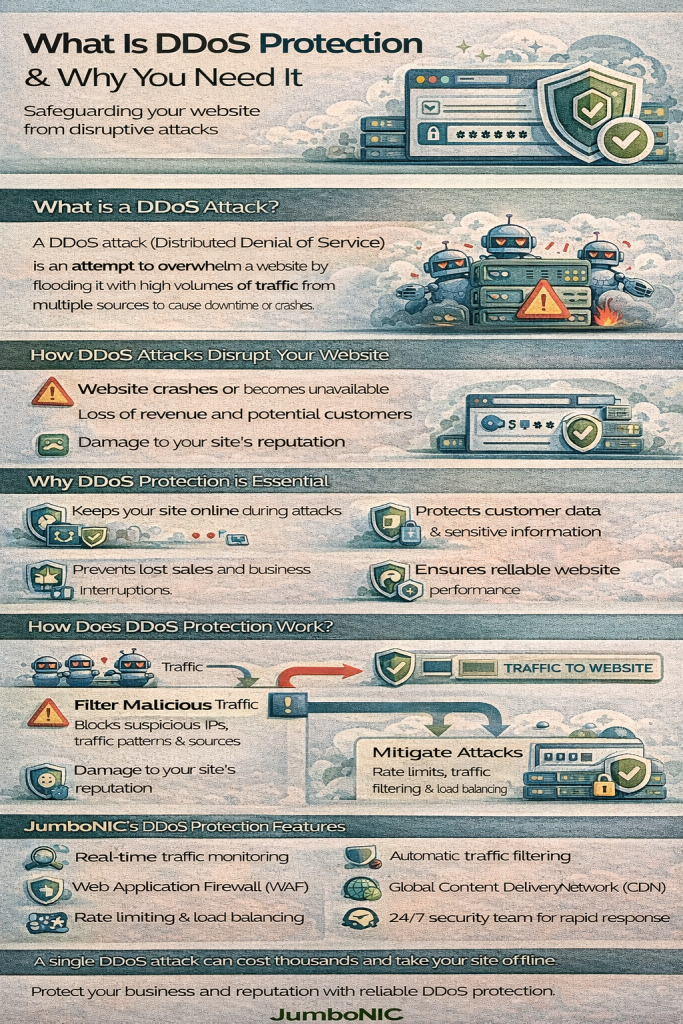
What Is a DDoS Attack?
A Distributed Denial of Service (DDoS) attack occurs when multiple compromised devices, often part of a botnet, flood a website with traffic. The goal is to overwhelm the server, making your site slow, unstable, or completely inaccessible.
Common types of DDoS attacks include:
Volumetric attacks: Overwhelm bandwidth with massive amounts of traffic.
Protocol attacks: Exploit weaknesses in server protocols (e.g., TCP, SYN flood).
Application layer attacks: Target specific website functions, like login pages or APIs, to disrupt service.
Even a short downtime caused by a DDoS attack can impact user trust, SEO rankings, and revenue.
Why You Need DDoS Protection
1. Maintain Website Availability
Without protection, DDoS attacks can take your site offline for hours—or even days. Reliable protection ensures your website stays accessible to legitimate users.
2. Protect Revenue and Conversions
E-commerce sites and subscription services lose money during downtime. DDoS protection safeguards your sales and customer trust.
3. Preserve Reputation
Website outages erode credibility. Users expect fast and reliable experiences, and repeated downtime can damage your brand.
4. Reduce Server Load
DDoS attacks overload server resources. Protection filters malicious traffic before it reaches your origin server, preventing crashes and slowdowns.
5. Improve SEO
Search engines penalize sites with frequent downtime. Effective DDoS protection helps maintain your site’s SEO rankings.
How DDoS Protection Works
DDoS protection typically uses a combination of techniques to detect and mitigate malicious traffic before it affects your server:
1. Traffic Filtering
Malicious requests are identified and blocked, while legitimate visitors continue accessing your site.
2. Rate Limiting
Controls the number of requests a user or IP can make in a given time, reducing abuse.
3. CDN Integration
Traffic is routed through a Content Delivery Network (CDN), distributing the load across multiple servers to absorb attacks.
4. Intrusion Detection Systems
Advanced systems monitor unusual traffic patterns and automatically respond to threats in real-time.
JumboNIC’s DDoS Protection
JumboNIC offers built-in DDoS mitigation to protect websites of all sizes. Here’s how it helps:
🚀 1. Global Anycast Network
Spreads traffic across worldwide nodes, reducing the impact of volumetric attacks.
🔥 2. Real-Time Traffic Filtering
Blocks malicious bots and traffic spikes automatically, keeping your site stable.
⚡ 3. Layer 3/4 and Application Layer Protection
Covers both network-level attacks and application-specific threats.
🛡 4. No Impact on Performance
Unlike some protection methods that slow down sites, JumboNIC ensures your site remains fast for legitimate users.
🌍 5. CDN & Edge Integration
By combining DDoS protection with a global CDN, traffic is intelligently routed to minimize server stress.
🧠 6. Continuous Monitoring
JumboNIC’s systems detect unusual activity 24/7 and respond instantly to mitigate threats.
Best Practices Beyond DDoS Protection
Even with JumboNIC’s protection, follow these additional security measures:
Keep software up-to-date (CMS, plugins, and frameworks)
Use strong passwords and 2FA for all accounts
Limit unnecessary open ports and services
Monitor traffic patterns for unusual spikes
Have an incident response plan ready
These steps complement DDoS protection to create a robust security posture.
Conclusion
A DDoS attack can strike at any time, and without proper protection, it can take your website offline, cost revenue, and damage your reputation.
JumboNIC’s DDoS protection combines global CDN integration, real-time filtering, and advanced mitigation techniques to keep your site online, secure, and performing at top speed.
With this level of protection, you can focus on growing your business—without worrying about disruptive attacks.