
The Evolution of DNS: From A Records to Anycast Networks
The Domain Name System (DNS) is often called the phonebook of the internet, but it has evolved far beyond its simple beginnings. What started as a straightforward system for mapping domain names to IP addresses has grown into a global, distributed, performance-driven network powering nearly everything online.
Today, businesses rely on DNS not only for accessibility, but also for speed, uptime, security, and global reach.
In this article, we explore the evolution of DNS—from the early days of static A records to the modern era of Anycast DNS—and how hosting providers like JumboNIC are helping organizations achieve faster, safer, and more reliable online experiences.
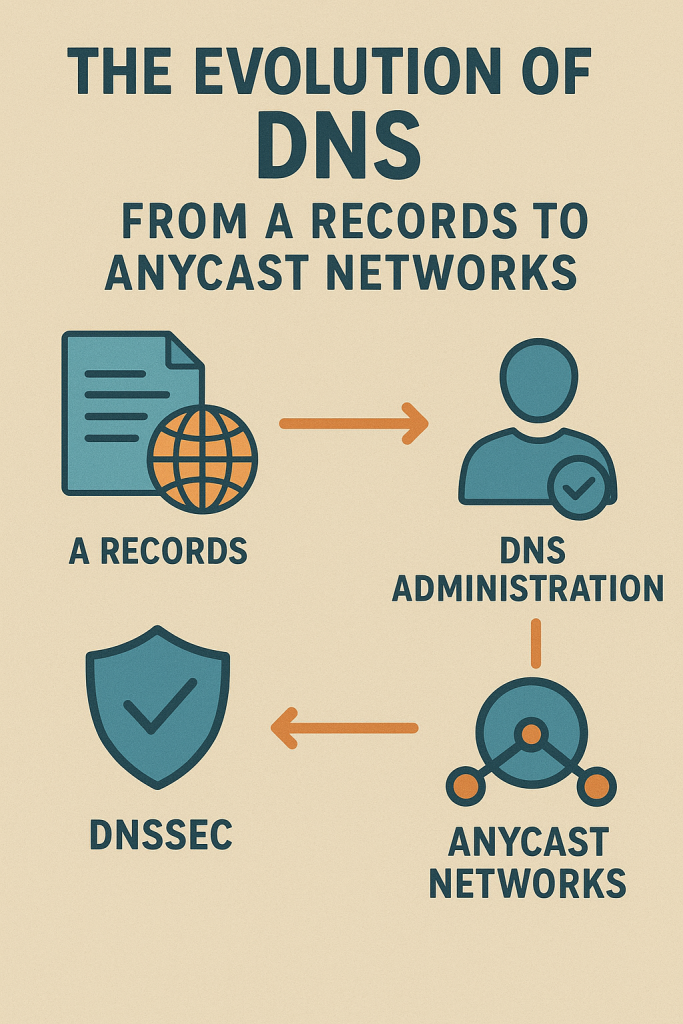
1. The Early Days of DNS: Mapping Names to IPs
When DNS was first introduced in the 1980s, its role was simple:
Convert human-readable domains (like example.com) into machine-readable IP addresses.
The core building block was the A record, which pointed a domain to a single IPv4 address.
These early DNS systems were:
Centralized
Static
Manually managed
Limited in scalability
Back then, DNS wasn’t optimized for speed or global distribution—it was purely functional.
2. The Growth of the Internet: Introducing More Record Types
As the web expanded, DNS needed to handle more:
Email
Subdomains
Load balancing
IPv6
Security
This led to new DNS record types, including:
✔ AAAA Records
For IPv6 addresses.
✔ CNAME Records
Aliases pointing one domain to another.
✔ MX Records
Directing email flow.
✔ TXT Records
Used for authentication (SPF, DKIM), verification, and policies.
✔ SRV Records
For service discovery.
DNS became more complex, flexible, and essential for modern internet services.
3. Performance Becomes Critical: The Need for Faster DNS
As websites got heavier and global traffic increased, DNS lookup times started impacting:
Page speed
SEO
User experience
Conversion rates
Traditional DNS used Unicast, which meant:
One server per IP
Traffic routed to one physical region
Bottlenecks and slow responses for distant users
This model could not support a growing global internet.
5. Modern DNS = Security + Speed + Reliability
Today’s DNS does much more than resolve domain names.
Modern DNS includes:
DNSSEC for preventing spoofing
Failover and load balancing
Traffic routing optimization
DDoS protection
Redundant global nodes
DNS caching for speed
Zero-downtime propagation
DNS is now a key performance and security layer—not just networking infrastructure.
6. How JumboNIC Delivers Next-Generation DNS
JumboNIC incorporates modern DNS technology to give businesses both speed and reliability.
Here’s how:
🌐 Anycast Global DNS Network
JumboNIC uses distributed Anycast DNS nodes for:
Faster DNS lookups globally
Lower latency for international visitors
Improved uptime and resilience
🔒 DNSSEC Support for Stronger Security
Prevents:
DNS hijacking
Cache poisoning
Spoofing attacks
⚡ Ultra-Fast Response Times
Optimized DNS servers ensure minimal lookup time—boosting both performance and SEO.
📊 Intelligent Routing
Traffic automatically routes through the closest and fastest DNS node.
🛡 DDoS-Protected Infrastructure
Distributed Anycast architecture absorbs attacks across multiple regions.
📈 Easy Management Dashboard
JumboNIC provides a user-friendly DNS management panel with:
Instant propagation
Simple record editing
Automated configurations
Modern DNS shouldn’t be complicated—JumboNIC makes sure it isn’t.
7. What This Evolution Means for Businesses
Understanding the evolution of DNS helps businesses make smarter hosting and infrastructure decisions.
✔ Faster load times worldwide
DNS speed is a crucial part of page speed—and conversions.
✔ Improved global reach
Anycast DNS helps businesses deliver consistent performance to international audiences.
✔ Better reliability
No more single-point DNS failures.
✔ Stronger security posture
DNSSEC and Anycast reduce cyberattack vulnerability.
✔ Greater customer trust
Reliable DNS = reliable website = better user experience.
Businesses that depend on online performance need modern DNS capabilities—not outdated, slow, single-server setups.
Conclusion: From Simple Lookups to Global Networks
DNS has transformed remarkably over the years. What began as a basic system mapping names to IP addresses is now a global, secure, performance-optimized infrastructure critical to the entire internet.
Anycast DNS represents the peak of this evolution, enabling faster, more resilient, and more secure access for users worldwide.
With advanced DNS technologies integrated into its hosting platform, JumboNIC ensures businesses stay ahead—delivering speed, uptime, and trust at every level of their online presence.