
The Connection Between Web Performance and Bounce Rate
In today’s fast-paced digital world, web performance directly impacts user engagement. A slow-loading website frustrates visitors, decreases conversions, and can increase your bounce rate—when users leave your site after viewing only one page.
Understanding the link between web performance and bounce rate is essential for improving user experience, retaining visitors, and boosting SEO. With JumboNIC’s high-performance hosting, optimizing website speed has never been easier.
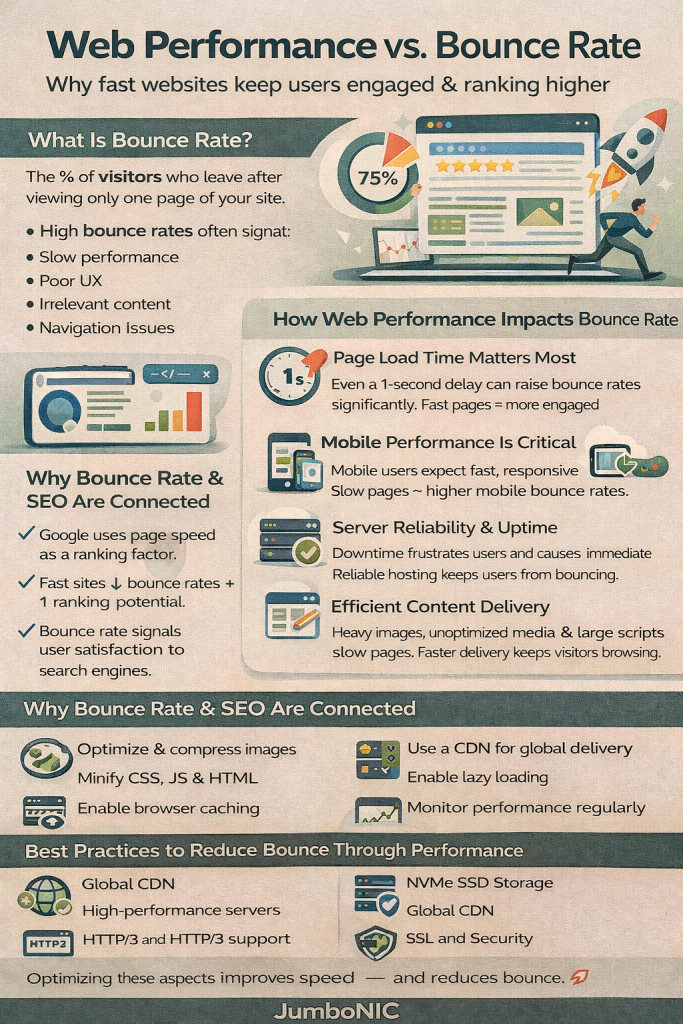
What Is Bounce Rate?
Bounce rate is the percentage of visitors who leave your website after viewing a single page without interacting further. A high bounce rate can signal:
Slow website performance
Poor content relevance
Bad user experience
Navigation issues
Search engines may also interpret a high bounce rate as a sign of low-quality content, potentially affecting rankings.
How Web Performance Impacts Bounce Rate
1. Page Load Time
Studies show that even a 1-second delay in load time can increase bounce rates by up to 20%.
Users expect instant access to content; delays frustrate and drive them away.
JumboNIC Advantage: JumboNIC’s NVMe SSDs, optimized server stack, and global CDN drastically reduce load times, keeping visitors engaged.
2. Mobile Performance
Mobile users are particularly sensitive to slow websites.
Poor mobile optimization leads to high bounce rates and reduced conversions.
JumboNIC Advantage: JumboNIC ensures mobile-first performance with responsive hosting, HTTP/3 support, and CDN delivery.
3. Server Reliability and Uptime
Downtime or intermittent server errors increase bounce rate since visitors can’t access content.
Unreliable hosting frustrates repeat visitors and damages credibility.
JumboNIC Advantage: JumboNIC offers 99.99% uptime and DDoS protection, ensuring your site is always accessible.
4. Efficient Content Delivery
Large media files, unoptimized images, and heavy scripts slow pages down.
Visitors may abandon pages before fully loading.
JumboNIC Advantage: JumboNIC provides global CDN caching, image optimization, and resource compression, delivering content faster to users worldwide.
5. Impact on SEO
Google considers page speed as a ranking factor, especially for mobile search.
Slow-loading sites not only increase bounce rate but also risk lower visibility in search results.
JumboNIC Advantage: With high-performance hosting and server-side optimizations, JumboNIC improves both speed and search rankings.
Best Practices to Reduce Bounce Rate Through Web Performance
Optimize Images and Media – Compress and serve images in modern formats (WebP, AVIF).
Minify CSS, JS, and HTML – Reduce page weight and improve load times.
Enable Browser Caching – Store static resources locally for faster repeat visits.
Use a Content Delivery Network (CDN) – Serve content closer to the user’s location.
Implement Lazy Loading – Load images and videos only when visible on the screen.
Monitor Performance – Use tools like Google PageSpeed Insights or GTmetrix.
JumboNIC Advantage: JumboNIC’s hosting platform integrates CDN, caching, and performance monitoring, making these optimizations effortless.
Why JumboNIC Makes a Difference
By combining fast servers, global CDN, DDoS protection, and automated optimization, JumboNIC ensures your website performs at its best. Faster load times reduce bounce rates, improve user satisfaction, and increase conversions.
Key benefits include:
Speed: NVMe storage, HTTP/3, and CDN reduce latency.
Reliability: 99.99% uptime ensures visitors can always access your site.
Security: DDoS protection and monitoring maintain performance under traffic spikes.
Optimization: Built-in caching and compression minimize page load times.
Conclusion
Web performance is a crucial factor influencing bounce rate. Slow, unreliable websites frustrate users, reduce engagement, and hurt SEO. By improving speed and reliability, you can lower bounce rates and enhance user experience.
With JumboNIC, businesses get high-performance hosting combined with advanced optimization features, ensuring that every visitor enjoys a fast, seamless, and engaging experience. Fast websites mean happy users—and happy users mean better conversions and retention.