
HTTP/3 Explained: The Future of Faster Web Browsing
As websites grow more complex, speed and reliability have become critical for delivering great user experiences. Modern users expect instant page loads, smooth interactions, and stable connections—even on mobile networks. To meet these demands, the web is evolving once again with HTTP/3, the latest generation of the Hypertext Transfer Protocol.
HTTP/3 is built to make the internet faster, more reliable, and more secure than ever before. In this article, we break down what HTTP/3 is, why it matters, and how JumboNIC fully supports this cutting-edge technology to accelerate your website.
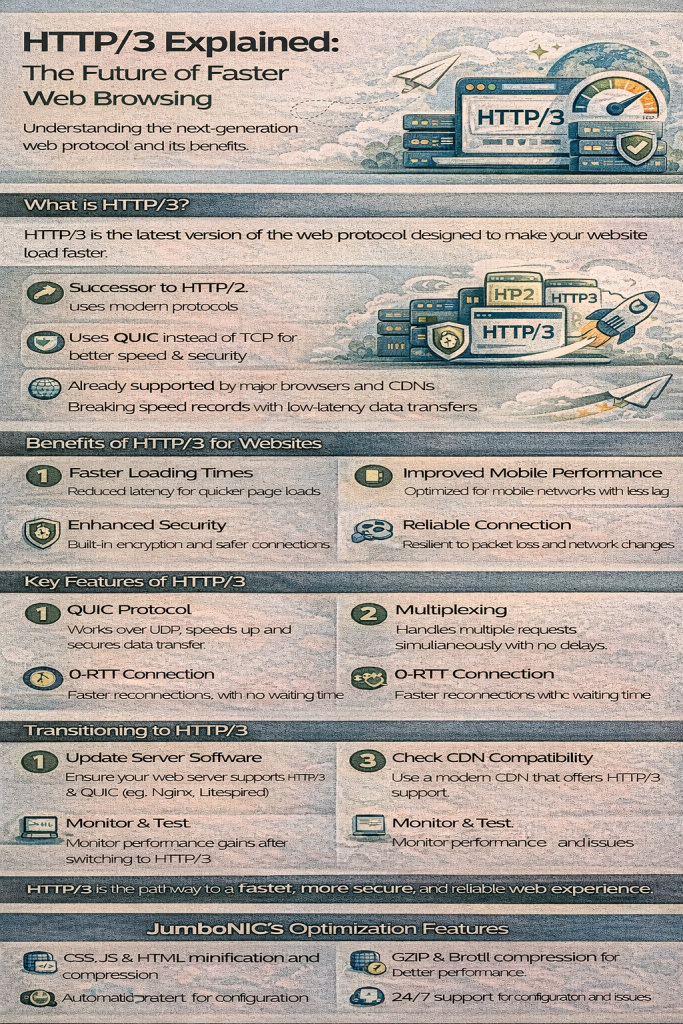
What Is HTTP/3?
HTTP/3 is the newest version of the protocol that powers nearly all web communication. Unlike previous versions (HTTP/1.1 and HTTP/2), which rely on TCP (Transmission Control Protocol), HTTP/3 uses QUIC, a modern transport protocol built by Google and later adopted as an internet standard.
QUIC runs over UDP instead of TCP, allowing for:
Faster connections
Fewer delays
Better recovery from network issues
Improved security
This makes HTTP/3 especially beneficial for mobile users and regions with unstable networks.
Why HTTP/3 Matters
As the web grows, so do the challenges:
Heavy images and scripts
Increased number of requests
Mobile browsing on spotty networks
Rising performance standards from Google
HTTP/2 was a significant improvement over HTTP/1.1, but it still suffered from limitations due to its reliance on TCP. HTTP/3 solves many of these bottlenecks.
Key Benefits of HTTP/3
1. Faster Page Loads with Reduced Latency
Because HTTP/3 uses QUIC, it eliminates slow TCP handshakes.
With HTTP/3, the browser can establish a secure connection much faster, even on:
Slow networks
Congested public Wi-Fi
High-latency mobile data
This translates into quicker page loads and improved Core Web Vitals.
JumboNIC Edge:
JumboNIC enables HTTP/3 by default on its optimized hosting and CDN, ensuring your site benefits from lower latency worldwide.
2. No More Head-of-Line Blocking
A major issue in HTTP/2 is head-of-line blocking. If one request in a connection is delayed, all others get stuck waiting.
HTTP/3 solves this by giving each stream its own independent path. If one resource is slow, everything else continues loading smoothly.
Benefits include:
Faster rendering
More reliable asset delivery
Better performance during high traffic
3. More Stable Connections on Mobile Networks
Mobile users often switch between Wi-Fi, 4G, and 5G. Under TCP, this disrupts connections, causing elements to reload or stall.
QUIC in HTTP/3 uses connection IDs that persist even when the user changes networks.
That means:
Zero interruptions
Faster recovery
More resilient browsing
Perfect for users on the move.
4. Built-In Encryption
HTTP/3 requires encryption as part of the protocol—there’s no unencrypted version.
This improves:
Data protection
Privacy
Security
Compliance
With JumboNIC:
All JumboNIC traffic is secured with modern TLS and QUIC encryption standards.
5. Better Performance Under Heavy Load
HTTP/3 is designed to handle:
High-traffic websites
Large media files
Streaming content
Real-time applications
By reducing latency and improving concurrency, HTTP/3 keeps performance stable even during traffic spikes.
JumboNIC’s caching and CDN infrastructure amplify these benefits across global regions.
How HTTP/3 Works (Simple Breakdown)
✔ Runs on QUIC
QUIC is a modern transport protocol built on top of UDP.
✔ Uses multiplexing
Each resource loads independently.
✔ Avoids packet-level delays
Lost packets only affect the stream they belong to.
✔ Maintains persistent connections
Even with network switches.
✔ Includes built-in TLS security
Faster and more secure than previous versions.
In short: HTTP/3 is streamlined, fast, and engineered for today’s mobile-first internet.
HTTP/3 vs HTTP/2: What’s the Difference?
| Feature | HTTP/2 | HTTP/3 |
|---|---|---|
| Underlying Protocol | TCP | QUIC (UDP) |
| Connection Speed | Slower handshake | Instant handshake |
| Head-of-Line Blocking | Yes | No |
| Mobile Stability | Moderate | Excellent |
| Encryption | Optional | Required |
| Packet Loss Behavior | Affects all streams | Affects only one stream |
HTTP/3 clearly outperforms HTTP/2 in nearly every category.
How JumboNIC Supports HTTP/3
JumboNIC is built with next-generation performance technologies. All hosting plans and CDN services come with:
🚀 1. HTTP/3 Enabled by Default
No configuration needed—just upload your site and go.
🌍 2. QUIC-Powered Global CDN
Deliver content faster across all continents.
💾 3. Edge Caching + Brotli Compression
Modern optimizations that pair perfectly with HTTP/3.
⚡ 4. NVMe Hosting for Lower TTFB
Fast backend performance complements faster network protocols.
🔒 5. Strong TLS 1.3 Security
Works seamlessly with QUIC for encrypted connections.
🔄 6. Automatic Fallback to HTTP/2
Ensures compatibility with older devices and browsers.
With JumboNIC, your website automatically gains all the advantages of HTTP/3 with no effort required.
Should You Enable HTTP/3? (Short Answer: Yes)
If you want:
Faster global performance
Better mobile experiences
Higher Core Web Vitals scores
Future-proof optimization
Stronger security
…then HTTP/3 is a must-have technology in 2025 and beyond.
And with JumboNIC, you get it instantly the moment your site goes live.
Conclusion
HTTP/3 represents the next step in the evolution of the web—faster, more secure, and optimized for modern browsing conditions. Its use of QUIC, built-in encryption, and elimination of old TCP bottlenecks make it a powerful upgrade for any website.
With JumboNIC, you don’t just get access to HTTP/3—you get a performance-focused hosting platform designed to make the most of it. From global CDN acceleration to NVMe-powered servers, JumboNIC ensures your site loads quickly, reliably, and securely for every visitor.