
How to Use Structured Data (Schema Markup) for Better Rankings
Search engine optimization (SEO) is no longer just about keywords and backlinks. Structured data, also known as schema markup, has become a powerful tool to help search engines understand your content better and enhance your visibility in search results.
In this article, we’ll explain what structured data is, why it matters for SEO, and how to implement it effectively—using JumboNIC to ensure your website remains fast, secure, and optimized for search engines.
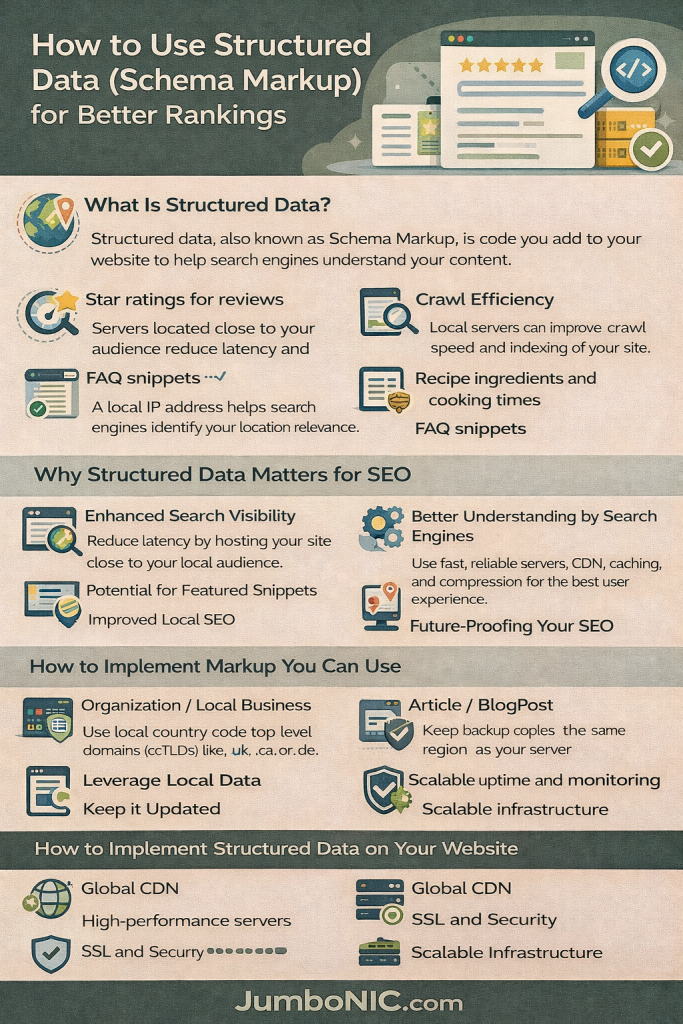
What Is Structured Data?
Structured data is a standardized format for providing information about a page and classifying its content. By using schema markup, you make it easier for search engines to interpret your website’s content and present it in rich results, such as:
Star ratings for reviews
Product pricing and availability
Event dates and locations
Recipe ingredients and cooking times
FAQ snippets
Example:
<script type="application/ld+json">
{
"@context": "https://schema.org",
"@type": "Product",
"name": "JumboNIC Hosting Plan",
"image": "https://example.com/hosting.jpg",
"description": "High-performance, secure hosting with global CDN.",
"brand": "JumboNIC",
"offers": {
"@type": "Offer",
"url": "https://jumboNIC.com/plans",
"priceCurrency": "USD",
"price": "19.99",
"availability": "https://schema.org/InStock"
}
}
</script>
Why Structured Data Matters for SEO
Enhanced Search Visibility
Rich results stand out in SERPs, increasing click-through rates (CTR).Better Understanding by Search Engines
Schema markup provides context about your content, helping Google, Bing, and others understand what your page is about.Potential for Featured Snippets
Proper structured data increases the chance of appearing in position zero or other SERP features.Improved Local SEO
Local business schema improves visibility in map results and local searches.Future-Proofing Your SEO
As search engines evolve, structured data ensures your content is machine-readable and compatible with new search features.
Types of Schema Markup You Can Use
Organization / Local Business – Business info like name, address, and logo
Product / Offer – Product details, pricing, and availability
Article / BlogPost – Author, publication date, and headline
Event – Dates, locations, and ticket info
FAQ & HowTo – Questions and answers, step-by-step guides
Breadcrumb – Hierarchical site navigation
How to Implement Structured Data on Your Website
1. Choose the Relevant Schema Types
Select schema types based on your content:
E-commerce: Product, Offer, Review
Blog: Article, FAQ
Local business: Organization, LocalBusiness
Events: Event
2. Add Schema Markup to Your Pages
Use JSON-LD, recommended by Google, for embedding structured data in the
<head>or<body>.Alternatively, microdata can be used, but JSON-LD is cleaner and easier to maintain.
JumboNIC Advantage: JumboNIC’s servers support fast page delivery with minimal impact from additional structured data scripts.
3. Test Your Structured Data
Use Google’s Rich Results Test or Schema.org validator to check for errors.
Correct errors to ensure search engines can read the markup accurately.
4. Monitor Performance
Track rich result performance via Google Search Console.
Adjust schema based on CTR, impressions, and indexing reports.
5. Keep It Updated
Schema markup should reflect the latest information (prices, stock, event dates).
Outdated data may mislead users and negatively impact rankings.
Best Practices for Schema Markup
Use Only Relevant Schema – Avoid overloading pages with unnecessary markup.
Stay Consistent – Ensure schema aligns with visible page content.
Leverage Automation – Plugins for WordPress or CMS platforms can generate schema automatically.
Combine With Speed Optimizations – Excess scripts should not slow down page load times.
JumboNIC Advantage: JumboNIC provides high-performance hosting and global CDN, so your site remains fast even when structured data is added to multiple pages.
How JumboNIC Supports SEO and Structured Data Implementation
High-Speed Hosting – Ensures that additional schema scripts don’t impact page load times.
Global CDN – Distributes content efficiently to users worldwide.
SSL and Security – Secure websites are favored by search engines.
Scalable Infrastructure – Supports large websites with hundreds or thousands of pages implementing schema.
By combining structured data with JumboNIC’s fast and secure hosting, you can maximize both user experience and search engine performance.
Conclusion
Structured data is a powerful SEO tool that enhances your website’s visibility, improves CTR, and helps search engines understand your content. Proper implementation can lead to rich results, featured snippets, and better rankings.
With JumboNIC, you can implement schema markup efficiently while ensuring fast, secure, and reliable hosting. Structured data and high-performance hosting together create a winning combination for SEO success.