How to Leverage Internal Linking for SEO Growth: Insights from JumboNIC
Internal linking is one of the most underrated yet powerful SEO techniques. While backlinks get most of the spotlight, internal links are the hidden framework that strengthens your site’s authority, user experience, and overall search performance.
At JumboNIC, we’ve seen firsthand how a smart internal linking strategy can turn a good website into a high-ranking powerhouse. In this guide, we’ll show you how to leverage internal linking for SEO growth — the right way.
1. What Is Internal Linking?
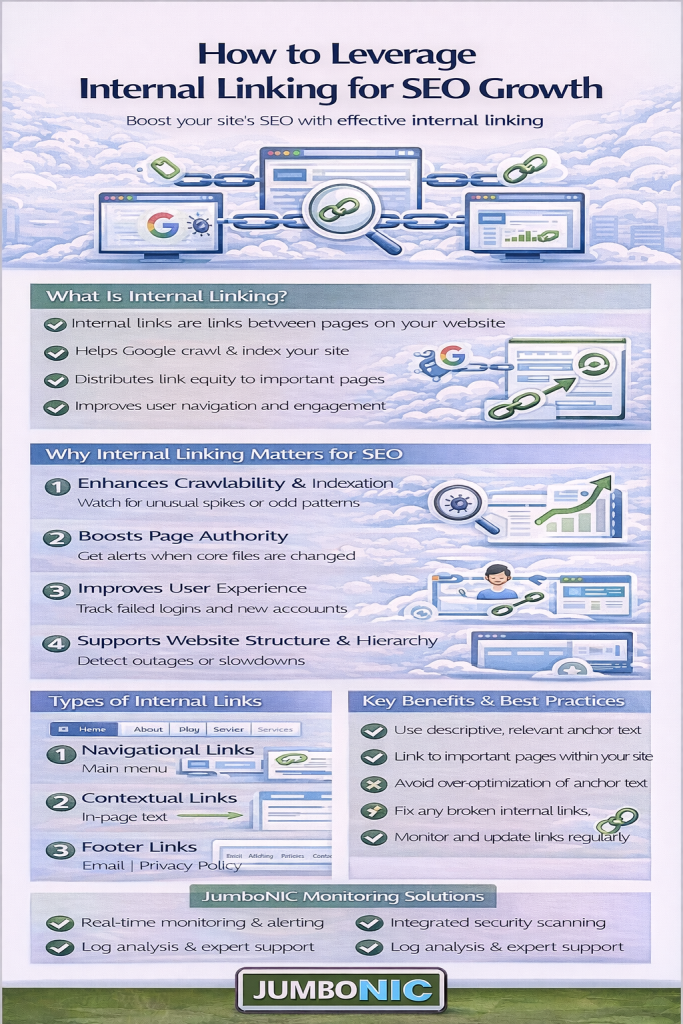
Internal links are hyperlinks that connect one page of your website to another page within the same domain.
They help:
Guide users through related content
Distribute link equity (ranking power) across pages
Help search engines crawl and understand your site structure
In short, internal links are like digital bridges that make your site more navigable — both for users and search bots.
2. Why Internal Links Matter for SEO
Search engines like Google use internal links to discover new pages and understand their relationships. When a page with high authority links to another internal page, some of that authority (often called “link juice”) is passed along.
Here’s what a strong internal linking strategy can do:
Boost rankings for key pages
Increase crawl efficiency and indexing speed
Improve user engagement and dwell time
Reduce bounce rates by guiding visitors to relevant content
JumboNIC Tip: Our SEO hosting infrastructure helps ensure that your sitemap, URLs, and internal linking structure are easily crawled and indexed for maximum visibility.
3. Build a Logical Site Structure
Before adding links, ensure your website’s architecture makes sense. A clear hierarchy helps both users and search engines understand where everything belongs.
Ideal structure:
Homepage
Category Pages
Subcategory Pages
Individual Content Pages
Each level should link naturally to the next. Avoid orphan pages (pages with no incoming links) — they’re invisible to search engines.
JumboNIC Insight: Use our site management tools to generate visual maps of your internal links and identify weak spots in your structure.
4. Use Contextual Internal Links
Contextual links — links placed within your content — are the most valuable for SEO. They help Google understand the topic and relevance of your pages.
Example:
If you’re writing about website performance, link naturally to another page like “How to Optimize Images for SEO and Speed.”
Best Practices:
Use descriptive anchor text (avoid “click here”)
Link to related, valuable pages
Don’t overdo it — 2–5 contextual links per 1,000 words is a good balance
5. Focus on Anchor Text Optimization
Anchor text (the clickable text in a hyperlink) tells search engines what the linked page is about.
For instance:
✅ Good: Learn more about JumboNIC’s SEO optimization tools
❌ Bad: Click here for more
JumboNIC Recommendation: Use natural, keyword-rich anchors — but vary them to avoid over-optimization.
6. Strengthen Your Pillar and Cluster Pages
A great internal linking structure supports the pillar-cluster model, where:
Pillar pages are comprehensive guides on broad topics
Cluster pages cover subtopics and link back to the main pillar
This creates a semantic relationship that signals to Google which pages are most important.
JumboNIC Example:
Your “SEO Basics” pillar page can link to cluster articles like “Image Optimization,” “Technical SEO,” and “Internal Linking Strategies.”
7. Regularly Audit Your Internal Links
SEO isn’t “set and forget.” Over time, new pages get added, and old ones may be deleted — which can create broken links and disrupt your internal structure.
Tools to help you audit:
Google Search Console
Screaming Frog SEO Spider
JumboNIC’s built-in Link Health Analyzer, which detects and fixes broken links automatically.
8. Measure and Optimize
Track the performance of your internal links over time:
Which links drive the most traffic?
Which pages have too few internal links?
Where can you improve anchor text diversity?
JumboNIC’s SEO Dashboard gives you insights into crawl depth, page authority distribution, and link flow to help fine-tune your internal linking network.
Final Thoughts
Internal linking is more than a technical SEO tactic — it’s a strategic framework for user experience, authority building, and long-term growth.
By creating smart, relevant connections between your pages and monitoring them consistently, you’ll help both your visitors and search engines find the value in your content.
With JumboNIC’s SEO-driven infrastructure, you can build a site that’s not just linked — but truly connected.