
How to Combine SEO and UX for Higher Conversions
For years, SEO (Search Engine Optimization) and UX (User Experience) were treated as separate strategies. SEO focused on ranking, while UX focused on usability and design. But today, search engines—and users—expect websites to excel at both.
A site that ranks well but frustrates users won’t convert. A beautifully designed site that can’t be found in search won’t convert either.
The real wins come from combining strong SEO with exceptional UX. In this article, we’ll explain how to merge both disciplines to boost conversions—and how JumboNIC’s fast, stable hosting plays a crucial role in creating a seamless experience from click to conversion.
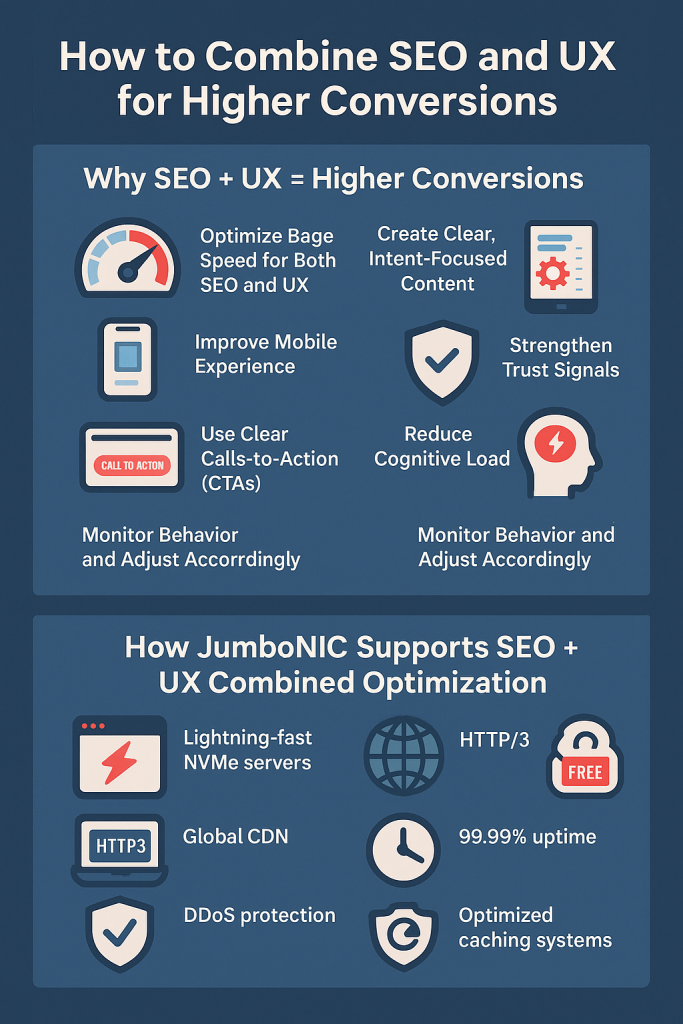
Why SEO + UX = Higher Conversions
SEO brings users to your website.
UX ensures they stay, engage, and ultimately convert.
When SEO and UX work together:
Users find your site faster
Pages load quickly
Content answers questions clearly
Navigation feels effortless
Users trust your site enough to take action
Search engines reward these behaviors with better rankings.
1. Optimize Page Speed for Both SEO and UX
Speed is the foundation of great SEO and UX. Slow sites suffer:
Higher bounce rates
Lower rankings
Frustrated users
Fewer conversions
Google’s Core Web Vitals are now critical ranking signals — all of which are tied to UX.
JumboNIC Advantage:
JumboNIC boosts page speed with:
NVMe SSD storage
Global CDN
HTTP/2 & HTTP/3 support
Server-level caching
Fast hosting directly improves rankings and user satisfaction.
2. Create Clear, Intent-Focused Content
SEO is not about stuffing keywords; it’s about matching search intent. UX requires content that is:
Clear
Scannable
Helpful
Well-structured
Together, they produce content that ranks and converts.
Tips:
Use headings to break up sections
Answer questions early and directly
Include visuals where relevant
Avoid long, unbroken text blocks
This approach helps both search engines and users understand your content quickly.
3. Improve Mobile Experience
Over 60% of online traffic comes from mobile devices. That means:
Mobile UX issues hurt conversions
Slow mobile pages hurt SEO
Poor mobile layout frustrates users
JumboNIC Advantage:
JumboNIC’s optimized hosting and CDN improve mobile load times globally.
Ensure your site:
Uses responsive templates
Has readable text and easy navigation
Loads quickly on mobile networks
Avoids intrusive pop-ups
4. Simplify Navigation
A well-structured site helps:
Search engines crawl and index pages
Users find what they need faster
Conversion paths remain clear
Best Practices:
Keep navigation simple and intuitive
Use breadcrumb navigation
Group content into clear categories
Maintain a shallow but organized site structure
Good navigation reduces friction and increases conversions.
5. Strengthen Trust Signals
Users convert more when they trust your website.
Trust signals include:
SSL & HTTPS
Fast loading pages
Professional, modern design
Clear contact information
Real testimonials or reviews
Secure checkout process
JumboNIC Advantage:
JumboNIC provides free SSL, secure servers, and 99.99% uptime—essential elements for trust.
6. Use Clear Calls-to-Action (CTAs)
SEO brings users to landing pages. UX ensures those pages convert.
Effective CTAs are:
Visible
Action-driven
Benefit-focused
Placed strategically
Examples:
“Get Started Fast”
“Download the Free Guide”
“Try JumboNIC Hosting Today”
CTAs bridge the gap between interest and action.
7. Reduce Cognitive Load
User Experience is as much about psychology as design.
Reduce friction by:
Using clean layouts
Eliminating unnecessary steps
Providing clear directions
Keeping forms short
Ensuring fast response time after button clicks
The easier your site is to use, the more conversions you’ll get.
8. Monitor Behavior and Adjust Accordingly
Combining SEO and UX isn’t a one-time task—it’s ongoing.
Monitor:
Bounce rate
Scroll depth
Click-through rate
Conversion paths
Page load speed
Exit pages
Tools like Google Analytics, Hotjar, and Search Console provide insights into where users drop off and how to improve.
How JumboNIC Supports SEO + UX Combined Optimization
JumboNIC’s hosting infrastructure gives you everything you need to create a fast, secure, user-friendly website:
Lightning-fast NVMe servers
Global CDN for lower latency
HTTP/3 for modern connection speed
Free SSL for trust and security
99.99% uptime
DDoS protection
Optimized caching systems
With JumboNIC, the technical foundation of both SEO and UX is solid—allowing you to focus on content, design, and conversions.
Conclusion
SEO gets users to your website.
UX convinces them to take action.
Together, they create a powerful conversion engine.
By optimizing speed, clarity, navigation, trust signals, and mobile experience—and using high-performance hosting like JumboNIC—you’ll create a site that ranks better, delights users, and drives more conversions.