
How Hosting Affects Crawl Budget and Indexing Speed
For websites aiming to rank well in search engines, crawl budget and indexing speed are critical factors. While content quality and SEO practices are often emphasized, your web hosting setup plays a major role in determining how efficiently search engines can crawl and index your site.
This article explains how hosting impacts crawl behavior, indexing speed, and overall search performance, and highlights how JumboNIC helps maximize SEO potential.
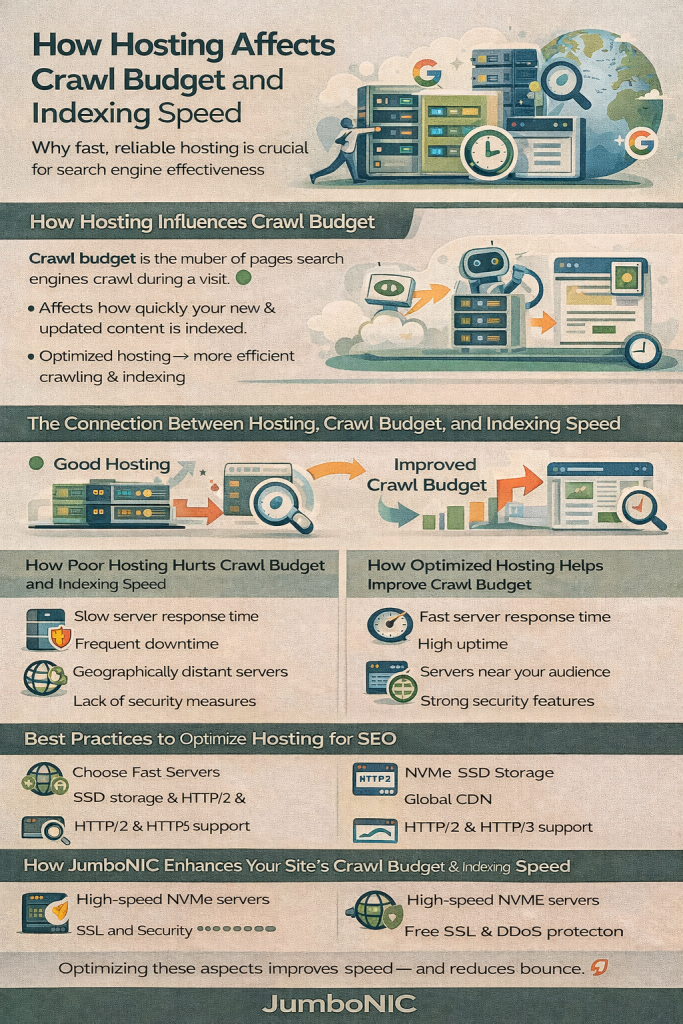
How Hosting Affects Crawl Budget and Indexing Speed
1. Server Response Time
Slow server response times reduce the number of pages crawled by search engines.
If a page takes too long to load, crawlers may stop or limit requests.
Google prioritizes fast-loading sites when allocating crawl budget.
JumboNIC Advantage: JumboNIC’s NVMe storage, high-performance servers, and global CDN reduce server response times, enabling crawlers to access more pages efficiently.
2. Uptime and Reliability
Frequent downtime can hurt indexing and crawl frequency.
Search engines may reduce crawl rates if the server is unstable.
Pages unavailable during crawling risk not being indexed or updated.
JumboNIC Advantage: JumboNIC offers 99.99% uptime with DDoS protection, ensuring crawlers can reliably access your site at all times.
3. Geographic Location of Servers
Crawlers often prioritize servers closer to their location for faster access. Hosting far from your target audience can slow crawl speed.
JumboNIC Advantage: JumboNIC provides globally distributed datacenters and CDN nodes, reducing latency and improving crawl efficiency worldwide.
4. Handling High Traffic and Spikes
If your server struggles under high traffic, crawlers may be throttled or blocked.
Overloaded servers slow down crawling and indexing.
Search engines may temporarily lower crawl rates to avoid server strain.
JumboNIC Advantage: JumboNIC’s scalable hosting infrastructure and load-balancing handle traffic spikes without impacting crawler access.
5. HTTP/2 and HTTP/3 Support
Modern protocols like HTTP/2 and HTTP/3 allow multiple requests to be served simultaneously over fewer connections.
Reduces latency for search engine crawlers
Speeds up page indexing
JumboNIC Advantage: JumboNIC supports HTTP/2 and HTTP/3, allowing faster crawling and efficient indexing of large sites.
6. Secure and Consistent Access (HTTPS)
Search engines prefer secure sites and may prioritize HTTPS-enabled websites for indexing.
Mixed content or intermittent HTTPS availability can confuse crawlers
HTTPS improves trust and indexing priority
JumboNIC Advantage: JumboNIC provides free SSL certificates, automatic HTTPS enforcement, and HSTS support, ensuring consistent, secure access for crawlers.
Additional Hosting Best Practices for Crawl Budget Optimization
Enable Caching – Reduces server load and speeds up page delivery.
Optimize Robots.txt – Prevent unnecessary pages from being crawled.
Use Sitemaps – Help crawlers discover and prioritize important pages.
Monitor Crawl Stats – Use Google Search Console to track crawl errors and speed.
Minimize Redirects – Excessive redirects can waste crawl budget.
How JumboNIC Supports SEO and Crawl Efficiency
With JumboNIC, your hosting environment is optimized for both performance and search engine efficiency:
High-speed servers and global CDN for faster page delivery
Reliable uptime to ensure crawlers can access all pages
HTTP/2 and HTTP/3 for modern, efficient connections
HTTPS by default for secure, trusted indexing
Scalable infrastructure to handle high traffic without throttling
These features help maximize your crawl budget, accelerate indexing, and improve overall SEO performance.
Conclusion
Hosting plays a pivotal role in how search engines crawl and index your website. Slow response times, downtime, and poorly configured servers can limit crawl budget and delay indexing, even if your content is high-quality.
With JumboNIC, you get high-performance, globally distributed, and secure hosting, ensuring search engine crawlers can efficiently access your website. Optimizing hosting isn’t just about speed—it directly impacts your site’s visibility and SEO success.