
Why You Should Use HTTPS Everywhere — Not Just on Login Pages
When securing a website, many website owners focus only on encrypting sensitive areas, such as login pages or payment forms. While this is better than nothing, limiting HTTPS to specific pages leaves your site vulnerable and can negatively impact performance, SEO, and user trust.
In this article, we’ll explain why HTTPS should be applied across your entire website, the benefits it provides, and how JumboNIC helps implement HTTPS seamlessly.
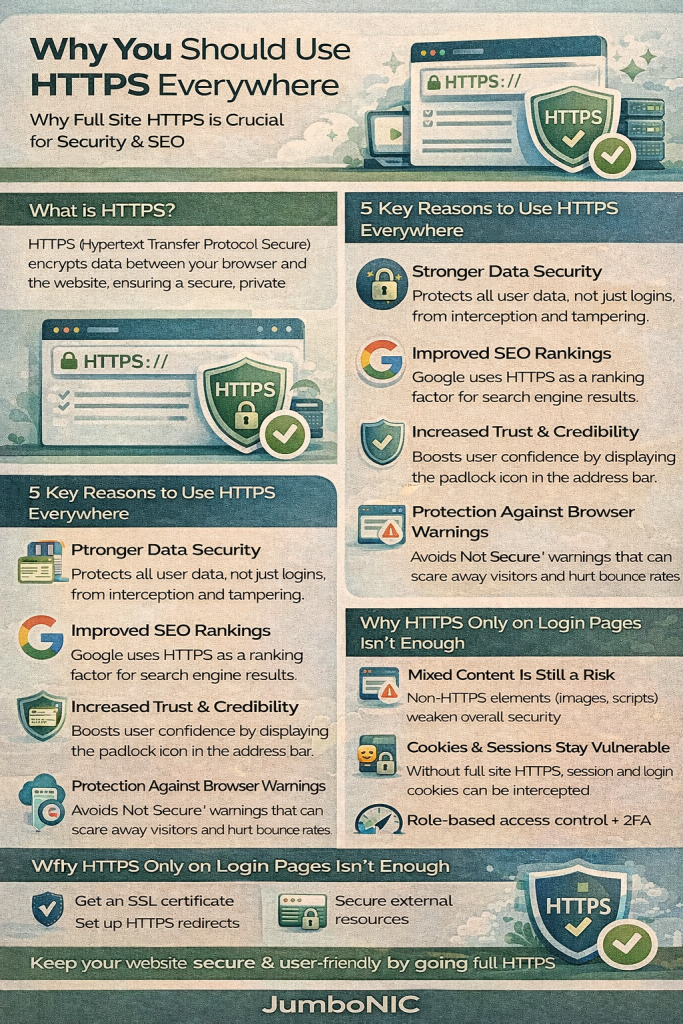
What Is HTTPS?
HTTPS (Hypertext Transfer Protocol Secure) is the secure version of HTTP. It encrypts data exchanged between a user’s browser and your website using SSL/TLS certificates, preventing attackers from intercepting or altering information.
Key benefits of HTTPS:
Data encryption for privacy
Integrity protection (prevents tampering)
Authentication of the website’s identity
Why Limiting HTTPS to Login Pages Is Not Enough
1. Protects All User Interactions
Even non-login pages can carry sensitive information, such as:
Personal information in forms
Search queries
Comments and messages
API calls
Encrypting only login pages leaves these data points exposed.
2. Prevents “Content Injection” Attacks
HTTP pages can be intercepted and modified by attackers. For example:
Injecting malware into scripts
Modifying images or ads
Redirecting users to malicious sites
HTTPS prevents attackers from tampering with content during transmission.
3. Improves SEO Rankings
Google uses HTTPS as a ranking signal. Sites using full-site HTTPS enjoy:
Better search visibility
Increased trust with users
Protection against “Not Secure” warnings in browsers
4. Boosts User Trust
Modern browsers mark HTTP sites as “Not Secure,” which can scare visitors away. Full HTTPS across your site:
Shows the padlock icon in browsers
Assures users their data is protected
Increases engagement and conversions
5. Supports Modern Web Features
Many new web technologies require HTTPS to function, including:
HTTP/2 and HTTP/3 for faster loading
Service workers and progressive web apps
Geolocation APIs
Secure cookies
Using HTTPS only on login pages may prevent these features from working correctly.
How to Implement HTTPS Everywhere
1. Obtain a Valid SSL/TLS Certificate
Free options: Let’s Encrypt
Paid options: Extended Validation (EV) certificates for trust badges
JumboNIC Advantage: JumboNIC provides free SSL certificates for all hosted domains, automatically configured and renewed.
2. Enforce HTTPS Site-Wide
Redirect all HTTP traffic to HTTPS using server rules or CMS settings
Update internal links and resources (images, scripts, stylesheets) to HTTPS
JumboNIC Advantage: JumboNIC automatically handles HTTPS redirection and ensures SSL is applied to all content, avoiding mixed content warnings.
3. Enable HSTS (HTTP Strict Transport Security)
HSTS tells browsers to always use HTTPS, preventing downgrade attacks.
Example header:
Strict-Transport-Security: max-age=31536000; includeSubDomains; preload
JumboNIC Advantage: JumboNIC supports HSTS configuration for secure and consistent HTTPS enforcement.
4. Use CDN with HTTPS
A global CDN ensures fast, secure delivery of your site’s content worldwide.
JumboNIC Advantage: JumboNIC’s global CDN delivers encrypted content from edge servers, reducing latency and improving both security and speed.
5. Test for Mixed Content
After migrating, ensure all resources (scripts, images, videos) load over HTTPS to avoid warnings.
Tools: WhyNoPadlock or browser developer tools
Why JumboNIC Makes HTTPS Everywhere Easy
JumboNIC combines speed and security with simplicity:
Automatic SSL certificates for all domains
Site-wide HTTPS enforcement
HSTS and secure headers for enhanced security
Global CDN with SSL/TLS support
Fast, reliable infrastructure that doesn’t slow down your website
By using JumboNIC, you can implement HTTPS across your entire website without technical headaches while maintaining optimal performance.
Conclusion
HTTPS is no longer optional—it’s essential for protecting user data, preventing attacks, improving SEO, and maintaining trust. Limiting HTTPS to login pages leaves your site vulnerable and undermines modern web features.
With JumboNIC, securing your entire website with HTTPS is simple, reliable, and performance-friendly. Encrypt every page, protect your visitors, and future-proof your website with site-wide HTTPS today.